Cranford Hospitality
September 3, 2025
Watershed Chattooga Duffel
September 17, 2026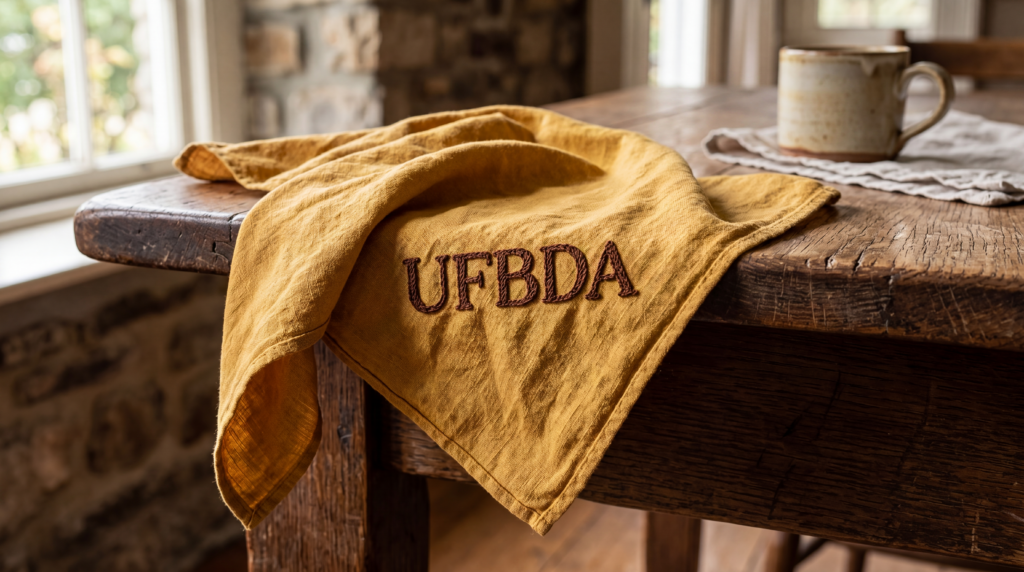
The Yellow Scarf
I reckon I’m getting old. That’s why I’ve decided to write all this down. I was writing my Last Will and Testament (not that I have much money to leave folks) but I realized the things I really wanted to leave to people, well they won’t hardly know what they are, so I figure I need to tell ‘em. I’m full of stories, but people are too busy for that these days. Anyway, I don’t even think I’m good at tellin’ tales, so I guess I feel better about writing them down and tucking them away. I suppose everybody collects stuff over the years, but I’ve tried to only hang onto the things that’s real beautiful to me, or make me remember something I love to remember. I’m gonna write about what each one of these things make me remember, and I might ramble, but darlings, my memory rambles these days, so it is what it is.
I have kept this yellow scarf for more than fifty years, though yellow has never done a thing for me. It is bright and bossy, about the color of mustard dried around the lid of the jar. Five letters are stitched across it—UFBDA—and there is a little brown stain on one corner that may be coffee or gravy. I have washed it more than once, but the spot has stayed put. I reckon it has earned the right.
UFBDA stood for the Upper French Broad Defense Association, which is too much name for one little scarf. Most people called us the dam fighters. Somebody called us the casserole lobby, and I always liked that better. There are worse things to be known for than showing up with supper when your neighbors are in trouble. The first casserole I carried to the North and South Mills River Community Center was chicken and rice. I put peas in it, which Earl considered a personal attack. “You know I don’t care for peas,” he said. I told him he could eat around them. “They’re mixed through the whole thing.” “Then you’ll get plenty of practice.”
That was in 1967, not so very long after Earl and I left Henry River. I have already told you about Mary and Boyce and Sheriff Oaks, and I do not care to make those memories get up and perform every time company comes. It is enough to say I arrived in Mills River with a baby growing inside me and a great deal of guilt riding along. Earl found work near Hendersonville, and we rented a little house with running water and a proper bathroom. I meant to tend my child, keep my house and mind my own business. The women of Mills River did not allow it. One brought pound cake before our boxes were unpacked. Another brought beans and cornbread after Mary was born. Miss Ruth arrived with stewed apples, explained which families were related and which ones were feuding, then invited us to the community center. I said we probably could not make it. “I’ll see you there around six,” she said, and that settled that.
The community center was a little cinder-block building off South Mills River Road. One family had given the land. Other people gave money and labor. The women held bake sales, and the men built the thing themselves because the church did not have a kitchen or enough room for wedding receptions and covered-dish suppers. They also wanted somewhere the young people could square-dance. The church was willing to help with many things, but it drew the line at dancing. The first night we went, somebody was playing fiddle and children were running between the chairs. Somebody took Mary from my arms before I had both feet through the door. “That’s Earl’s wife,” one person said. “That’s the new baby,” said another. Then somebody pointed toward my dish. “That’s the chicken casserole.” I suppose that was my introduction.
By the end of the night, the dish was scraped nearly clean. Three peas remained stuck in one corner, and Earl pointed at them as though they proved something. Later, somebody pulled us onto the floor. The last time I had danced with Earl was before Henry River, before the gunshots and everything that followed, and I had forgotten what it felt like to have his hand against my back. He stepped on my toe. I complained, but I laughed. That is the first thing I remember about Mills River. Not the farms or the church or even the river. I remember laughing while Earl stepped on my foot.
I first heard about the dam inside that same building. At first, I thought it was only talk. People were forever saying the government might build something somewhere—a road, a factory, a lake. Such plans seemed to live in newspapers and government offices, not in places where people actually lived. Then Miss Ruth pointed toward the floor. “They mean to put us under it.” I asked her, “Under what?” “The water,” she said.
The Tennessee Valley Authority had a plan to build fourteen dams across the upper French Broad country. They said the dams would control floods, improve the water and bring recreation and economic advancement. Economic advancement was a phrase we heard often. It generally meant somebody had plans for your property.
Hundreds of families would have to move. Farms, roads, houses, churches and community buildings would disappear, and Mills River was supposed to be among the first places flooded. I asked Earl whether the water would reach our house. “I don’t believe so,” he said. That comforted me for about three seconds. Then I understood what I had asked. It was an ugly thing to feel relieved because the water would stop at somebody else’s door.
Not everybody opposed the plan. Some thought a lake might bring tourists and money. Some were willing to sell and start over. Others had lived on their farms for five or six generations. They could point toward a field and tell you who cleared it, who planted the apple tree and which child nearly drowned at the old river crossing. The TVA colored its future lakes blue on the maps. The maps did not show any of that.
Jere Brittain had grown up where the North and South forks of Mills River came together. He had gone away to school and returned with his wife, Joanne, and their children around the same time Earl and I arrived. The difference was that Jere was coming home, and I was trying to escape mine. “Mills River’s my place,” he told me once. “I can feel it in my bones.” I understood what he meant, though I did not know whether I had such a place anymore. Jere did not pretend the river was harmless. One of his earliest memories was the flood of 1941, when the water spread across the valley until Mills River looked like a lake. That mattered because people supporting the dams sometimes talked as though anyone who opposed them did not understand floods. The people of Mills River understood water very well. They knew what the river gave them, and they knew what it could take.
The community center became the heart of the fight. The room people had built for wedding cakes and square dances filled up with folding chairs, government maps and worried families. The TVA sent men to explain why the dam would be good for us. They stood near the fireplace and talked about flood control, recreation and development with the calm confidence of people who believed the matter was already decided. They had a number for everything. Jere asked whether their figures included families who had lived on the same land for generations. Somebody asked what value they had put on the church. Another asked about the graveyard. The TVA men did not have much of an answer.
I sat near the back with my hands folded over my pocketbook, and on the way home, Earl glanced at me. “You were quiet.” “I generally am,” I said. He gave me a look. Earl knew better. After Henry River, I had promised myself I would stop meddling. I had gone to Sheriff Oaks because I thought a lawman could make things right. Then Sheriff Oaks was dead, Boyce was in prison and Mary had to live with everything that followed. People told me I had done the right thing, but the right thing had not felt right afterward. So I attended the meetings and said nothing.
But once you know a place has been marked for drowning, you begin noticing all the things that cannot swim. I noticed the church steeple above the trees and old women visiting graves after Sunday services. I noticed barns, gardens, porches and children standing barefoot in the river. I noticed the community center. The map showed blue water where all of it had been.
A map can make destruction look clean.
My meddling began with a stack of envelopes. Joanne Brittain asked whether I could help address a few. I said I could stay half an hour and stayed nearly three. After that came telephone calls, petitions and church notices. Somebody had to tell people when the next meeting was. Somebody had to carry papers to folks who did not drive. Somebody had to bring food when meetings lasted through supper. I made chicken and rice. Sometimes I left out the peas.
The little opposition groups from Mills River and the other threatened valleys eventually joined together as the Upper French Broad Defense Association. One of the women worked in textiles and made bright yellow scarves with UFBDA stitched across them. When Jere handed me mine, I held it up and said, “That is loud.” “That’s the point,” he answered. Earl watched me tie it around my neck. “You won’t be hard to find.” “That’s the point,” I told him.
In 1971, the TVA was finally made to hold a public hearing in Asheville. It lasted three days. The TVA arranged for people supporting the dams to speak first, while the reporters and cameras were most likely to be there. They meant for the news to show a room full of approval. Then the cameras turned toward the audience, and nearly everybody was wearing yellow. The room was hot, crowded and noisy. Folks brought food because three days is a long time to fight the federal government without sandwiches. At one point, a TVA man leaned toward the microphone and asked, “Ladies and gentlemen, can you hear me in the back?” “Talk louder,” I hollered. I had not planned to say it. It just came out. People laughed and clapped, and Earl turned his head and looked at me as though he had brought the wrong wife to Asheville. “What?” I whispered. He shook his head, but he was smiling.
Farmers spoke. Teachers spoke. Preachers quoted Scripture. People sang songs and read poems. Some had never spoken before a crowd and never would again. I had not planned to speak. Jere was saying it better than I could. But sometime during those three days, I wrote my name on the list. When they called me, my knees shook so badly I thought everybody could see. I carried a folded paper to the microphone, but the words I had written looked as though they belonged to somebody else.
“My name is Rosemary,” I said. “My husband and I rent in Mills River, so I don’t own any of the land you mean to take.” Then I looked back at all those yellow scarves. “But these people fed us when my baby was born. Their children play with mine. You keep telling us what the dam is worth. You have not told us what they are worth.” I lost my place, so I folded the paper. “I used to believe minding my own business kept trouble away,” I said. “It don’t.” The room was quiet. “We can hear you,” I told the TVA men. “I hope you can hear us.” That was all. I returned to my chair before I could spoil it by saying more, and Earl took my hand.
The TVA did not abandon the dams because of me. It took years of meetings, petitions, letters and elections. People changed their minds. County governments changed. In November 1972, the TVA announced it was giving up because it no longer had enough local support. What the TVA wanted, the TVA did not get.
I do not remember a grand celebration. The fight had divided neighbors, and we still had to sit beside one another at church and meet in the grocery store. Mostly, everybody was tired. But we had a supper at the community center. I brought chicken and rice. No peas that time.
For more than fifty years, I kept the yellow scarf as proof that we had done the right thing. The community center remained standing. People held birthday parties and wedding receptions there. Farms stayed in families. The church did not become a steeple beneath a lake. The dead stayed where their people had buried them. The old building eventually became home to the Mills River Partnership, where people worked to protect the same river the TVA had once planned to control by putting the community under it. I always liked the neatness of that.
Then Hurricane Helene came. Water tore houses apart. Roads vanished. Bridges moved. Whole communities seemed to have been picked up, shaken and put back down wrong. Afterward, I took the yellow scarf from my drawer. For the first time in fifty years, it did not feel like proof of anything.
The TVA had said the dams would control floods. I had not forgotten that. I had only spent half a century being glad they never got the chance. Maybe the dams would have taken some of Helene’s fury. I expect they would have. Maybe the river would not have risen quite so high. Maybe fewer houses downstream would have broken apart. Maybe some roads and bridges would have stayed where people built them. I do not know.
Being old has not made me as wise as I expected. Mostly, it has given me more time to question things I once believed I had settled. Then I remember that dams do not stop water without putting it somewhere. Maybe they would have saved one family’s house in 2024 by covering another family’s house in 1972. Maybe they would have protected land downstream by taking Mills River before the storm ever came.
For more than fifty years, people lived in the valleys the TVA meant to flood. They raised babies and buried parents. They planted gardens, married at the church and danced at the community center. They listened to the river making music over the rocks. Those years counted.
After Helene, people inside the community center helped families along the river. The building the neighbors had raised with donated land, bake-sale money and their own hands was still doing what they built it to do: giving the community somewhere to gather when they needed one another.
I do not reckon that settles the question. Rivers are too complicated for that, and so are people. Maybe the dams would have taken some of Helene’s fury, but they would have taken Mills River first.
3 Year Renewal
Original price was: $65.00.$50.00Current price is: $50.00.Single Issue
Original price was: $10.95.$9.95Current price is: $9.95.Subscription
Original price was: $32.00.$25.00Current price is: $25.00.