
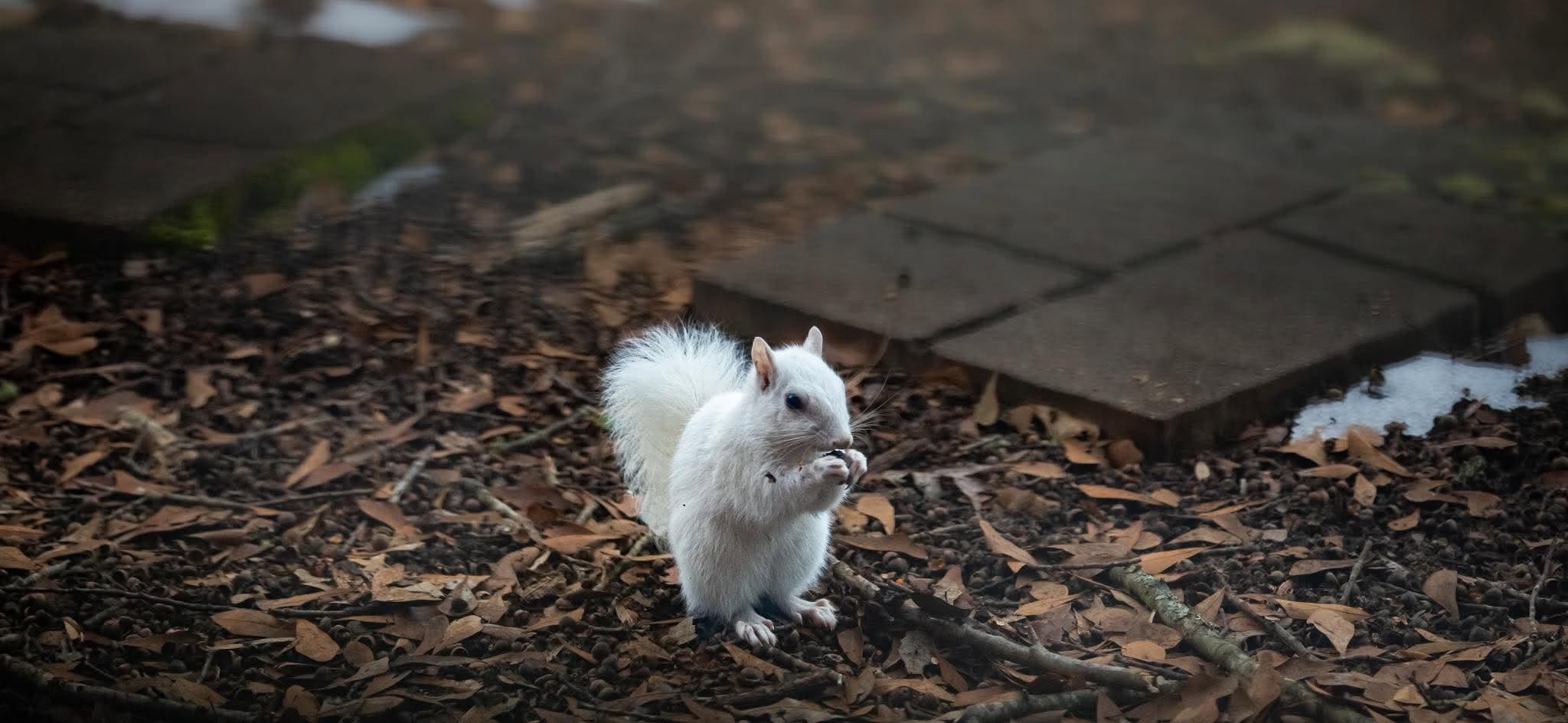
Hickory has white squirrels—and some people here remember seeing them for decades. They aren’t albino. Most have dark eyes and patches or streaks of gray, making them a rare color variation of the Eastern gray squirrel. They turn up in certain neighborhoods more often than others, but no one seems to have a complete picture of where they live or how far their population has spread. That’s where you come in.
Seen a white squirrel? Add it to the map. Drop a squirrel marker where you spotted it, and if you’d like, tell us when you saw it, what it looked like, or anything else you noticed. Over time, we hope these sightings will help us build a clearer picture of Hickory’s mysterious white-squirrel population—and maybe even help us uncover where they came from.
White Squirrel Sightings
Seen a white squirrel? Add it to the Foothills Digest community map.
White Squirrel Photo Album
Photos shared by Foothills Digest readers.
Hickory’s White Squirrels: What We Know, What We Don’t, and the Circus Story
If you’ve lived around Hickory long enough, there’s a decent chance you’ve heard someone say, “Oh yeah, we’ve always had white squirrels.” They aren’t nearly as famous here as they are in Brevard, North Carolina, where white squirrels have become a town mascot, tourist attraction and local obsession. But Hickory has its own population, and residents have reported seeing them for decades. Exactly where Hickory’s white squirrels came from, however, is much harder to answer.
First, they aren’t albino. White squirrels are often casually called albinos, but the squirrels most commonly seen in Western North Carolina are not true albinos. A true albino animal lacks melanin throughout its body and typically has very pale or pinkish eyes. The white squirrels seen around Brevard—and many of those reported around Hickory—usually have dark eyes and at least some darker pigmentation. Some have gray on the tops of their heads. Others have a gray stripe or darker streak running along their backs. They are Eastern gray squirrels with an inherited difference in pigmentation. You’ll often hear the word leucistic used to describe them. That generally refers to animals whose pigmentation has been reduced or distributed differently while their eyes retain normal coloring. The genetics can be a little more complicated than the word suggests, especially when individual squirrels still have clearly defined gray markings, but “leucistic” is much closer to the truth than “albino.”
The most famous white-squirrel population in North Carolina is in Brevard, about two hours southwest of Hickory. Brevard’s story begins in 1949. According to the traditional account, a man named H.H. Mull brought two white squirrels from Madison, Florida, and gave them to his niece, Barbara Mull. The squirrels were kept as pets and named Snowball and Frisky. Eventually, one escaped. The other was later released, and according to local history, those squirrels became the ancestors of Brevard’s growing white-squirrel population. That part of the story is fairly well documented.
But then comes the circus. The man in Florida who supplied the squirrels reportedly had a number of white squirrels living around his pecan grove. The story passed down about them was that the squirrels had originally escaped after a circus or carnival truck overturned nearby. It is a fantastic story. It also may not be true. Researchers studying the history of white squirrels have found reports of white, non-albino squirrels in Florida that predate the supposed circus accident. That raises the possibility that the squirrels were simply a naturally occurring color variation already living in the area. The circus explanation may have been folklore added later—or perhaps a good story used to explain why one Florida grove happened to have so many unusual squirrels.
There is also another important detail: the Florida squirrels were reportedly caught and distributed in pairs. That may matter a great deal. Once unusual white squirrels began attracting attention, people did something humans have always done with unusual animals: they wanted some of their own. Pairs of white squirrels were sometimes captured, given away, sold or relocated. There are documented examples of people intentionally introducing white squirrels into new communities. That helps explain something researchers have noticed about white-squirrel populations. If the squirrels had simply spread naturally outward from one original colony, we would expect their range to expand gradually. Instead, white-squirrel populations sometimes appear in scattered pockets separated by substantial distances. Human help is one very reasonable explanation. Someone sees unusual white squirrels, catches a pair, takes them home and releases them. A new little colony begins.
So did someone bring white squirrels to Hickory? Maybe. That is the question we would really like to answer. We have not yet found a reliable historical record identifying the person who introduced white squirrels to Hickory—or even proving that Hickory’s squirrels were introduced at all. Local residents, however, have reported seeing them for many years. Some Hickory-area sightings go back decades, and St. Stephens has long been one of the areas where people report encountering them. That creates several possibilities. Hickory’s squirrels could be descended from animals deliberately brought here from another white-squirrel population. They could be connected somehow to the Brevard population or to another colony established from the same Florida stock. Or white coloration could have arisen independently among local gray squirrels.
Rare white squirrels existed in North Carolina long before Brevard became famous for them. Newspaper accounts describing white squirrels in the state date back to at least the late 1800s. So simply seeing a white squirrel does not prove that it descended from Brevard’s Snowball and Frisky.
And what about the story that circus people gave squirrels to families? That rumor is especially interesting because it may contain pieces of two different stories. The first is the old claim that Florida’s original white squirrels came from an overturned circus or carnival truck. The second is the much better-supported fact that people really did catch unusual white squirrels and distribute them to other people. Over many decades, those two stories could easily have blended into something like: “Circus people used to give pairs of white squirrels to families.” We haven’t found evidence proving that exact version, but the idea of people receiving pairs of white squirrels and introducing them into new places is absolutely plausible—and documented elsewhere.
Which brings us back to Hickory. Somewhere in this area, there may still be a family that remembers exactly how these squirrels got here. Maybe someone’s grandfather brought home a pair. Maybe somebody remembers a neighbor who kept them. Maybe an old newspaper clipping mentions them. Maybe Hickory’s squirrels appeared naturally and have been here much longer than anyone realizes. That’s part of why we created this map. Every sighting gives us another piece of the puzzle. If enough people tell us where they’ve seen white squirrels—and especially how long they remember seeing them in particular neighborhoods—we may eventually be able to trace Hickory’s population backward. So if you see one, add your squirrel to the map. And if you remember white squirrels from Hickory years ago, we especially want to hear from you. Tell us where you saw them, approximately what year it was, and anything you remember about their history. There may be a very good Hickory story hiding in those memories.