

Settin’ Chairs: Silver River and the Art of Chair Caning in Western North Carolina
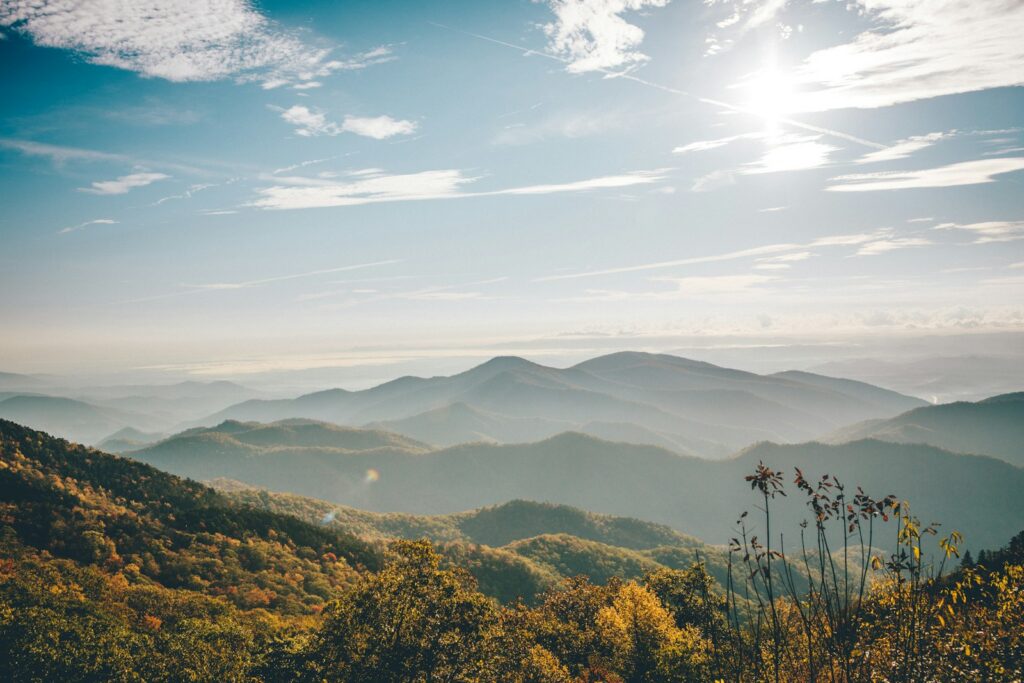
Living in western North Carolina means hearing several names for the mountains around us. A weekend trip might take us into the Blue Ridge, up to the High Country, or over to the Smokies. All of those places are Appalachian, and some of those names describe the same ground.
The confusion comes from using names that refer to different things. Some describe mountain ranges. Others describe a region shaped by its communities, history, and local identity. Their boundaries overlap, so a place can belong to several at once.
The Appalachians are the larger mountain system. The Blue Ridge is part of that system. The Great Smoky Mountains are a range within the broader Blue Ridge province. North Carolina’s High Country is a regional name for the mountain communities around Boone, Blowing Rock, and neighboring areas.
The Appalachians: The biggest geographic name
The Appalachian Mountains extend from Canada through the eastern United States into Alabama. Western North Carolina belongs to the southern portion of that enormous mountain system.
The Appalachians include many individual ranges. The Blue Ridge and Great Smoky Mountains belong to them, as do the White Mountains of New Hampshire and the Green Mountains of Vermont. Those places have different landscapes and local traditions, even though they share a larger mountain system.
There is also a difference between the Appalachian Mountains and Appalachia. The first describes physical geography. The second describes a region with cultural, historical, and economic connections, whose boundaries vary depending on who is drawing the map.
The Appalachian Regional Commission, for example, uses a congressionally defined region spanning parts of 13 states. That boundary serves a specific public purpose; it cannot fully capture where people feel Appalachian or how they understand their own communities.
Here in western North Carolina, “Appalachian” can describe both the land and a sense of belonging. That identity includes Cherokee communities, generations of mountain families, Black Appalachian history, and people whose work and traditions continue to shape the region.
The Blue Ridge: A broad mountain region within the Appalachians
The Blue Ridge is part of the Appalachian mountain system, stretching from southern Pennsylvania into Georgia. In western North Carolina, it includes much of the mountain landscape that people picture when they think of long, overlapping ridges fading blue into the distance.
There is a little terminology to sort out here. “Blue Ridge” can mean a particular mountain chain or the much broader Blue Ridge physiographic province, a region geologists identify by its landforms and underlying geology.
That broader province includes several named ranges, including the Black Mountains, home to Mount Mitchell, and the Great Smoky Mountains. This is why describing the Smokies as part of the Blue Ridge is accurate, even though travel guides often present them as separate destinations.
The Blue Ridge Parkway adds another familiar use of the name. It is a scenic road through the mountains, and its route passes through several mountain ranges. The road and the mountain region have different boundaries.
The High Country: A North Carolina region with flexible edges
In North Carolina, the High Country generally means the northwestern mountain region associated with Boone, Blowing Rock, Banner Elk, Grandfather Mountain, and surrounding communities.
Watauga, Avery, and Ashe counties sit at the center of how many people use the term. Broader definitions include neighboring counties, and tourism organizations, government agencies, and residents do not always draw the same boundary.
The High Country is a regional name rather than a separate mountain range. It describes a part of the Blue Ridge and Southern Appalachians known for high elevations, cool summers, ski slopes, Christmas tree farms, and mountain towns.
That means Boone can be in the High Country, the Blue Ridge, and the Appalachians at the same time. Each name tells you something different about where it is.
The term also does not mean every especially tall mountain in North Carolina. Mount Mitchell is the highest peak in the eastern United States, but elevation alone does not determine whether a place is commonly described as High Country.
The Great Smoky Mountains: A specific range along the state line
The Great Smoky Mountains rise along the border between western North Carolina and eastern Tennessee. They belong to the Southern Appalachians and form part of the broader Blue Ridge province.
They are a distinct mountain range, with their own name and geography. Great Smoky Mountains National Park protects a large portion of that landscape, with Cherokee and Bryson City serving as familiar gateways on the North Carolina side and Gatlinburg and Townsend on the Tennessee side.
The mountains and the national park are related, but their names are not interchangeable. One describes a natural range; the other describes protected land with established boundaries. Tourism businesses also use “the Smokies” for a wider surrounding area.
Their name comes from the natural haze and mist that often soften the ridgelines. Moisture and compounds released by vegetation help create that smoky appearance.
And the spelling is Smoky, without an “e,” in Great Smoky Mountains.
Where do the foothills fit?
Here around Hickory, another regional name belongs in the conversation: the foothills.
The foothills are the lower hills approaching the mountains, where the landscape transitions toward the steeper Blue Ridge. In everyday use, the name also describes communities with close connections to both the mountains and the Piedmont.
Hickory is generally described as a foothills city in the western Piedmont. Calling it part of the High Country would give someone the wrong impression of its setting. Yet Catawba County is included in the Appalachian Regional Commission’s region, illustrating how a place can be Appalachian under a regional definition without sitting high in the mountains.
A quick guide
| Name | What it describes | Where it fits |
|---|---|---|
| Appalachian Mountains | A major mountain system extending from Canada into the southeastern United States | The largest mountain grouping discussed here |
| Blue Ridge | A mountain chain and, in broader geological usage, a province containing several ranges | Part of the Appalachians |
| North Carolina High Country | A region centered around Boone, Blowing Rock, Banner Elk, and neighboring communities | Within the Southern Appalachians and Blue Ridge |
| Great Smoky Mountains | A specific range along the North Carolina–Tennessee border | Within the Southern Appalachians and broader Blue Ridge province |
| Foothills | Lower hills and communities approaching the mountains | Along the transition between the Piedmont and mountains |
If you are visiting Boone, you can accurately say you are in the High Country, the Blue Ridge, and the Appalachians. If you are hiking in the Great Smoky Mountains, you are also in the broader Blue Ridge province and the Appalachians, though you would not ordinarily describe that trip as a visit to North Carolina’s High Country.
These names help us describe the region at different scales, from a mountain system stretching across much of a continent to the particular communities just up the road.
The best of our hills, in your inbox.
One good story, beautiful mountain views, and around 20 ideas for the weekend—with festivals first. No clutter. Just Foothills This Week.