The Other Bigfoot Reports: A County-by-County Guide to North Carolina’s Strangest Sightings

The Bottomless Pools at Lake Lure — and the Boy I Met There
When I was five years old, I sat on a fallen tree trunk beside the Bottomless Pools at Lake Lure and had a conversation with someone nobody else could see.
My mother, aunt and uncle were there with me. They watched me talk, pause and listen. When they asked who I was speaking to, I told them his name was Treetrunk.
That’s where this story begins for me. But the Bottomless Pools had a history long before I got there, and some of that history is heartbreaking.
The place they called bottomless
Just outside Lake Lure, Pool Creek carved a series of extraordinary round basins into the rock. Water rushing into natural fractures creates swirling currents, and stones caught in those currents grind the rock deeper over time. The result is beautiful, but the smooth stone and deep, fast-moving water can also be dangerous.
Older than the lake
First, let me settle something I wondered about myself: the Bottomless Pools are older than Lake Lure. An 1881 travel guide was already telling people to see “the Pools” in Hickory Nut Gorge. The spot opened to visitors as an attraction by 1916, photographs of it survive from 1920, and a bridge was built over Pool Creek below the pools in 1925. The dam across the Rocky Broad River wasn’t completed until 1926, and Lake Lure wasn’t fully filled until 1927. The pools were there first.
In our original 2023 magazine story, I mentioned the possibility of ancient lava tubes. After digging deeper, I would not present that as the scientific explanation. A North Carolina historic survey identifies the pools as giant potholes eroded into bedrock. As Pool Creek crossed fractures in the Henderson granite gneiss, its current swirled and carried pebbles and stones around like grinding tools, wearing circular shafts deeper into the rock. One detailed geological guide gives estimates ranging from roughly 25,000 to 100,000 years for their formation, but acknowledges that scientists have not agreed on a precise age. This is old, patient work by moving water, not a lake-building project.
How deep are they? That question has been part of their appeal for a very long time. An archival photograph catalogued as 1920 carries a handwritten description claiming “300 feet deep,” while another historic postcard calls their depth “unknown.” Those are fascinating pieces of the folklore, but neither is a documented scientific sounding. I still haven’t found a reliable measured depth for the deepest fissures, and “bottomless” isn’t a literal geological description.
For generations, people came to marvel at the pools and wonder how deep they might be. F. Scott Fitzgerald even mentioned them in his story I’d Die for You. Lee Powers bought the property in 1937 and developed it into a popular attraction. His family continued to care for it for decades. By the time I researched our 2023 magazine story, the attraction had closed and the old picnic spot was being reclaimed by nature.
There is a darker part of the history, too. In 1985, a young boy drowned at the pools after slipping from a rocky ledge. A newspaper account at the time described calls for better warnings and safety measures. Later, stories circulated that a little boy could be seen around Lake Lure, and some employees at the nearby Lake Lure Inn spoke of hearing a child’s ball bouncing in the basement. Those are local haunting accounts, not proof of a ghost, but they became part of the lore surrounding the pools.
The Reconstruction-era secrets
And there is another history here that is much darker than a ghost story. F. Scott Fitzgerald wrote I’d Die for You (The Legend of Lake Lure) around 1935–36. Near the end, he refers to the pools as rumored to hold “black secrets of reconstruction days.” That line stopped me. Fitzgerald was writing fiction, and I cannot tell whether he heard the story locally or invented it, but by the 1930s he was connecting this particular place to the region’s violent past.
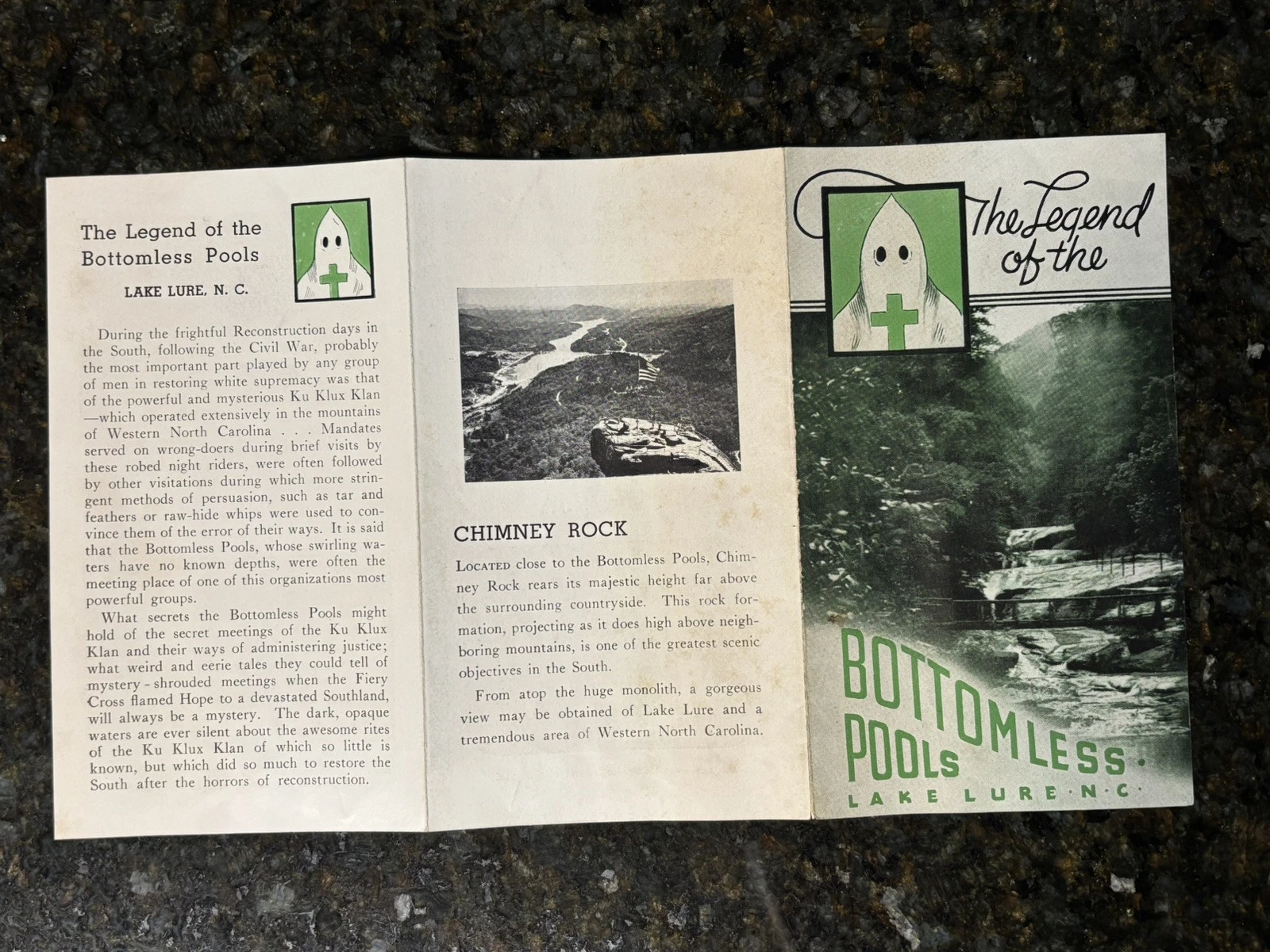
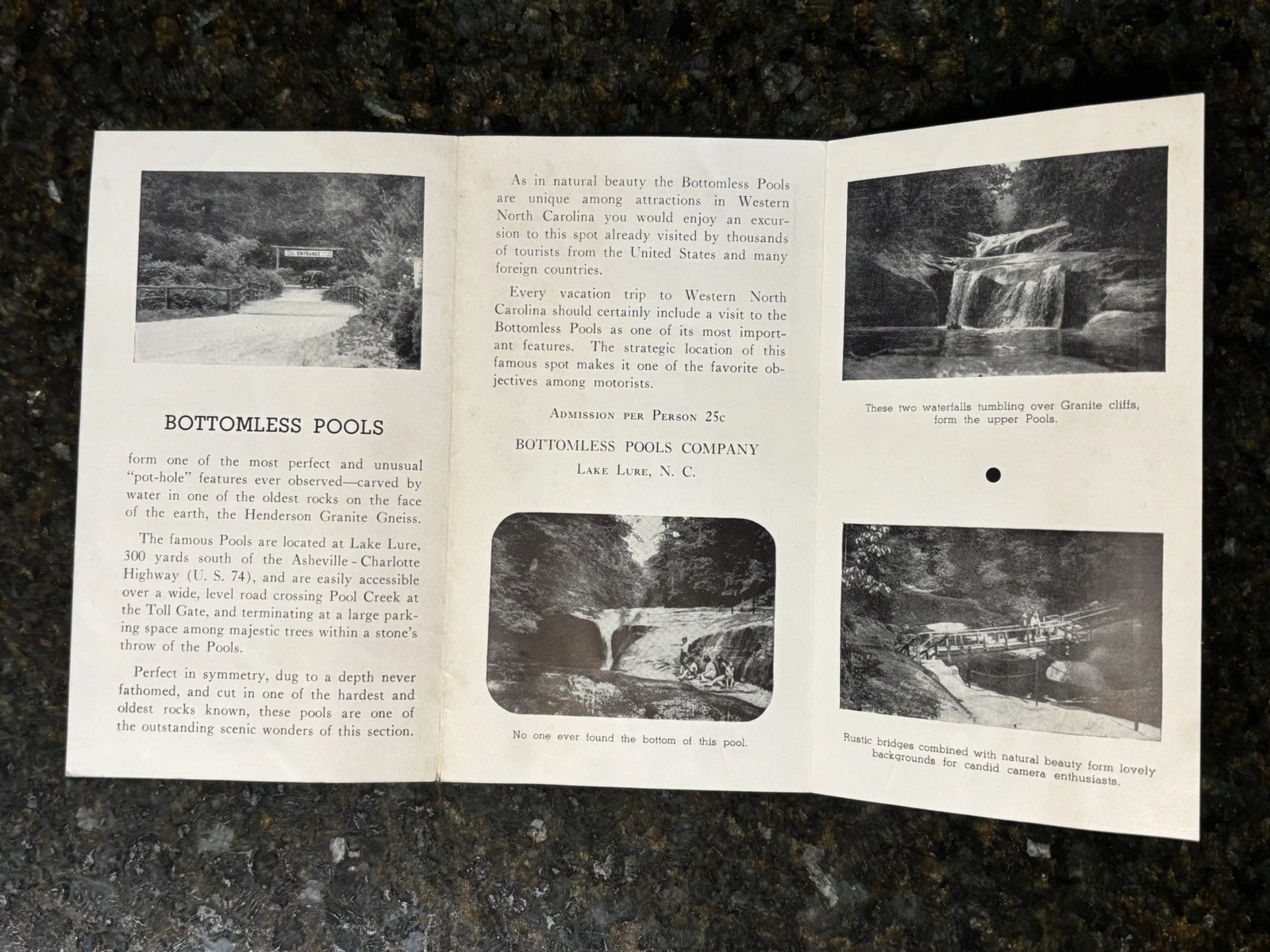
Then I found photographs of all six panels of an old brochure titled The Legend of the Bottomless Pools. The cover shows a hooded Klansman above a picture of the waterfalls. It isn’t subtle. One side presents the pools as a scenic tourist attraction, complete with photographs, directions, and a 25-cent admission price under the name Bottomless Pools Company. The other side openly praises the Ku Klux Klan and white supremacy. It describes night riders using threats, tar and feathers, and whips to terrorize people, while pretending those acts were a way of keeping order. It also claims the pools were said to be a meeting place for one of the area’s powerful Klan groups. That claim comes from the pamphlet itself; I haven’t independently verified that meetings occurred there.
Here is the brochure itself. These photographs document how a tourist attraction was promoted alongside openly racist Klan propaganda.
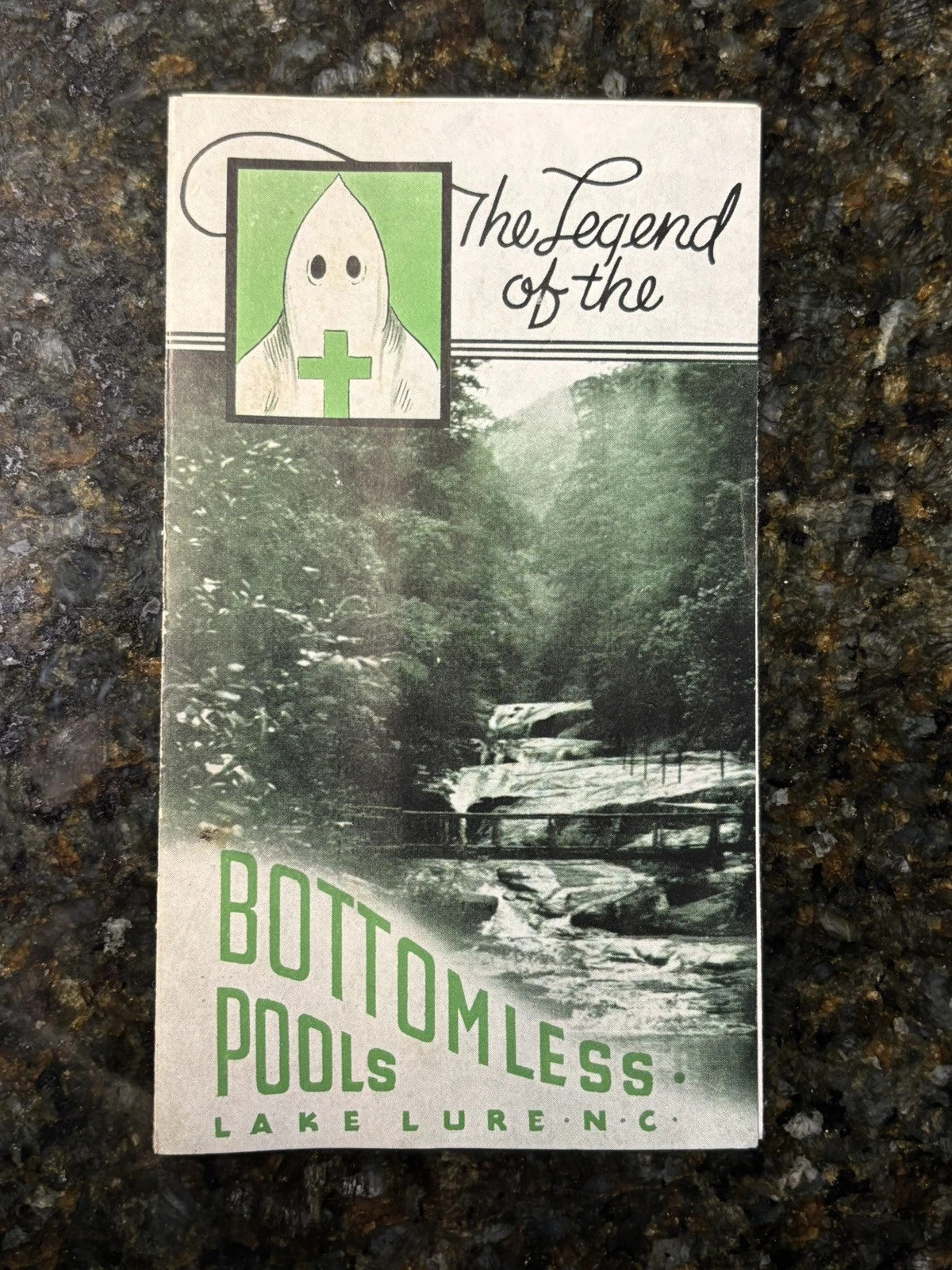
Historical material reproduced for critical documentation, not endorsement. Brochure photographs: vintage item listing.
This is an actual piece of Klan propaganda wrapped around a tourism advertisement. Seeing those words printed beside photographs of a place I remember visiting as a little girl makes the history much harder to dismiss as vague folklore. An auction catalog also documented a six-panel folder of the same title among Klan materials. A seller dates the tourist brochure to the 1940s, but I have not verified its publication year or identified its printer.
The Klan’s presence in Rutherford County, however, isn’t rumor. A North Carolina historic-preservation account documents the Klan’s stronghold there during Reconstruction. In June 1871, Klansmen were reported to have smashed the printing equipment of a Republican newspaper in Rutherfordton, and a Republican state legislator was threatened and whipped. Federal cavalry arrived later that month and remained into 1872. Another state history records that Judge George Washington Logan, whose family ran an inn in Hickory Nut Gorge, was a determined opponent of the Klan. This is the history of the area, not proof of a particular crime at the pools.
I have also heard the awful story that Klansmen murdered people and used the deep pools to hide their bodies. I have not found a contemporary newspaper report, court record, named victim, or other evidence that establishes those killings took place at this site. That part must remain an unverified account, especially because it concerns real people and real racial terror. I don’t want to erase a painful possibility from the story, but I won’t present an allegation as a documented murder, either.
The boy I called Treetrunk
I didn’t know any of those stories when I was a little girl. I only knew that the place was beautiful and that I had found someone to talk to.
I couldn’t see Treetrunk the way I could see the people around me. But I knew he was there. And when we left the Bottomless Pools, he came home with me.
For years afterward, I could talk with him by leaning my head against a tree. It didn’t have to be a particular tree. That was simply how I reached him. I don’t remember the things he said. What I do remember is how I felt: safe, and somehow outside of time. He remained part of my childhood until I was around eight.
Eventually I grew up, and the details of that first meeting slipped out of my memory. When I began researching the Bottomless Pools for Foothills Digest, my aunt reminded me of the day she and my family had watched me sitting on that log, having an earnest conversation with someone they couldn’t see. She remembered where it had happened. Suddenly, the origin of Treetrunk came back to me.
People use the phrase “imaginary friend” for a childhood companion like that. I’ve used it myself, sometimes with quotation marks. But I have never felt that he was simply imaginary. I believe I was talking to a spirit. I can’t prove it, and I wouldn’t pretend to know who he was or whether he had any connection to the tragedies at the pools.
I just know that I met him there, that he stayed with me for years, and that when I think about him now, I still remember the peace I felt in his company.
There are places that stay with us long after we’ve left them. And sometimes, it seems, something from those places comes home with us.
Research notes: Geology and early tourism: NCDOT historic survey and Sherpa’s account of Pool Creek. Early images and conflicting depth claims: UNC Asheville’s 1920 photograph and the George Masa postcard collection. Lake chronology: Town of Lake Lure. Fitzgerald’s manuscript dating: Princeton University Library. Reconstruction history: Rutherfordton Main Street Historic District nomination and Pine Gables nomination. The complete six-panel Legend of the Bottomless Pools brochure can be viewed in photographs of its front and back. HCA Auctions’ February 2020 catalog, lot 44, and an earlier collectibles listing also describe the item. Its publication date and claims of Klan meetings at the pools still require independent verification.
This story is adapted and expanded from my original feature in Issue #23 of Foothills Digest, Ghosties, Witches, Haints & Spirits, pages 36–37. The 2023 feature includes a historic photograph of the pools and a newspaper clipping about the 1985 drowning.
Safety note: The Bottomless Pools were marked as private, no-trespassing property when we reported the original feature. Please respect posted restrictions and never enter dangerous water or slippery rock areas.
The best of our hills, in your inbox.
One good story, beautiful mountain views, and around 20 ideas for the weekend—with festivals first. No clutter. Just Foothills This Week.