A Couple Says Bigfoot Jumped a Guardrail on Highway 64—In Broad Daylight
Bigfoot Hunters Found Something in McDowell County. Then a Man in a Fur Suit Came Forward.
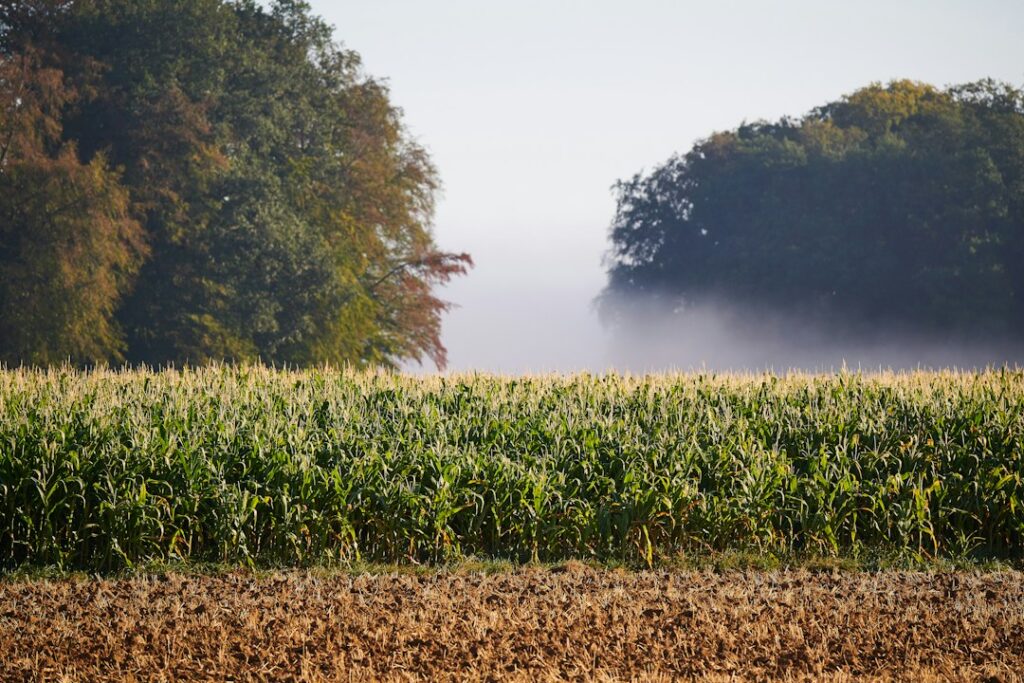
He Hid in a Wilkes County Cornfield in 1978. Then He Looked Behind Him.
He was 20 years old, out before sunrise, and trying very hard not to be seen.
Sometime in late August or September 1978, Ricky “Rick” Lunsford said he was walking a dirt road near Wilbar, in Wilkes County, waiting for his girlfriend's parents to leave for work so he could visit her. Headlights appeared in the distance. He slipped down into a cornfield beside the road and crouched out of sight.
He watched one set of headlights go past. Another followed. Then, while he waited among the corn stalks, he noticed a smell so bad that it made him turn his head.
He looked left. Nothing. He looked right. Still nothing.
Then he looked behind him.
At the edge of the woods, about 30 or 40 feet away, stood what Lunsford would later describe as a massive, hair-covered figure. It was looking directly at him, and it wasn't moving.
Lunsford had gone into that cornfield because he didn't want anyone to see him. According to his account, he came face to face with something he couldn't explain. And he would wait more than three decades before making the experience public.
A very specific place, at a very specific hour
His original account—Bigfoot Field Researchers Organization Report #27908—places the encounter near Roten Creek Road in Wilbar, off North Carolina Highway 16 north of North Wilkesboro. He remembered the time as approximately 5 to 5:30 a.m., when the sky was just beginning to lighten. The air was warm, the ground dry, and a creek ran on the other side of the road.
In the account he submitted in 2010, Lunsford said the roadside field lay at the bottom of a mountain. The figure stood near the point where the cornfield ended and the wooded slope began. He had felt uneasy during the walk, even before he saw the shape.
That detail about the headlights matters. They weren't there because something in the cornfield startled him; they were the reason he was hiding in the first place. According to Lunsford, both vehicles passed while he and the figure remained out of sight below the road.
And as far as the record shows, no one else directly witnessed his reported encounter.
He described a body as wide as a refrigerator
Lunsford told the BFRO that the figure stood somewhere between six and eight feet tall. He described an immense chest and shoulders, a slightly stooped or bowed back, no obvious neck, and dark brown hair roughly four or five inches long.
Its head, he said, was oval and somewhat pointed, with unusually large, dark eyes. He remembered seeing the fingers and thumb on one enormous hand. During her follow-up interview, BFRO investigator Sybilla Irwin recorded his estimate that the shoulders were about three feet across and the figure might have weighed 400 to 450 pounds.
Notice how unlike a traditional monster scene this is. Lunsford didn't describe a charge, a growl, or a creature baring its teeth. In his account, the figure simply stood at the woods' edge, motionless and silent, while they stared at one another.
It was his reaction that turned the moment frightening.
He said he felt frozen, unable to get his legs moving. When he finally ran, he crashed into a barbed-wire fence, tore his clothing, and kept going up the road, shouting.
He later told the investigator he didn't think the figure had intended to hurt him. He thought it might have been curious about the young man hiding on the edge of its territory.
One detail in the record actually changes
There is a small but revealing inconsistency in the account, and it's worth preserving rather than smoothing over.
In the original written submission, Lunsford said it took him approximately ten seconds to get moving once he saw the figure. In the investigator's follow-up notes, the time the two allegedly stared at one another becomes about thirty seconds.
That doesn't prove he invented anything. When people remember frightening experiences decades later, estimates of time can vary. But it reminds us what this evidence is: a person's recollection, recorded in 2010, of an encounter he says happened in 1978. No footage, diary entry, dated photograph or contemporaneous physical sample accompanies the story.
His claim about telling people also needs precision. The original submission says he told his girlfriend after running away and asked her not to tell anyone. Later news interviews say he kept the episode largely quiet for years, before telling children and grandchildren. That's different from saying he never told a soul.
Thirty-two years later, his daughter helped him report it
For decades, Lunsford largely kept his experience out of the public eye. According to Irwin's notes, he worried that people wouldn't believe a long-haired, 20-year-old young man who claimed to have met Bigfoot. He also reported nightmares about the encounter.
Then, in June 2010, another North Carolina Bigfoot story exploded into the news. Near Casar, Tim Peeler called 911 after claiming a towering, yellow-haired creature was bothering his dogs. Lunsford said hearing about new reports brought back the experience he'd never forgotten.
Lunsford contacted the BFRO; his daughter helped him submit the written account on June 21, 2010. Investigator Sybilla Irwin interviewed him repeatedly. She wrote that his description remained consistent through those conversations and assessed him as credible.
That investigator's confidence is a relevant part of the historical record, but it isn't independent confirmation that the figure was an unknown animal. A person can sincerely remember a frightening encounter and still be mistaken about what they saw—especially after 32 years.
The original witness-assisted sketches are still online
Here is where this case becomes much more interesting than a brief anecdote. The BFRO report preserves two original 2010 illustrations associated with the account. They were not imagined for this article, and they aren't generic stock pictures of Sasquatch.
Sketch 1: The face Lunsford remembered. Working with the witness, artist and investigator Sybilla Irwin produced a detailed grayscale portrait showing the dark eyes, heavy brow, broad nose, thick hair and unusual head shape he described. Open Lunsford's original witness-assisted facial sketch →
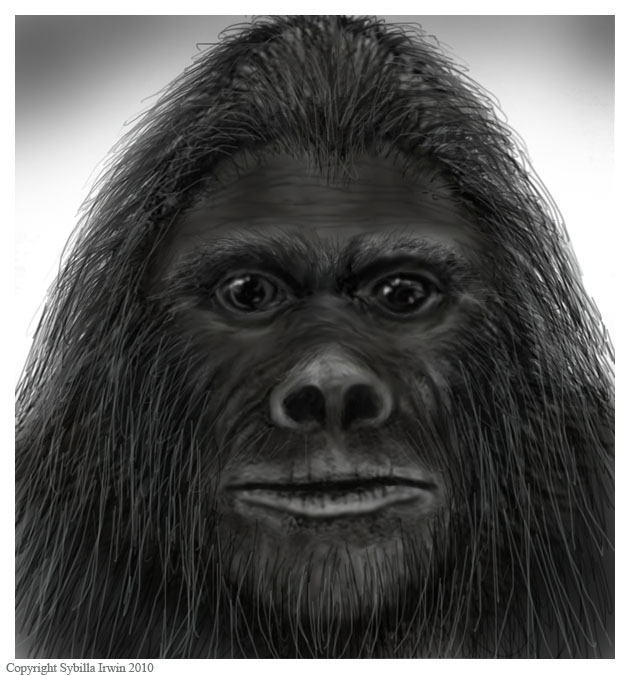
The face as reconstructed in 2010 from Lunsford's description. Drawing by Sybilla Irwin © 2010, courtesy of the BFRO case archive.
Sketch 2: The encounter in the cornfield. The second image depicts a crouched young man looking up at a huge figure beside a field and tree line. The BFRO says the composition drew on artwork submitted by Lunsford's brother. Open the original encounter illustration →
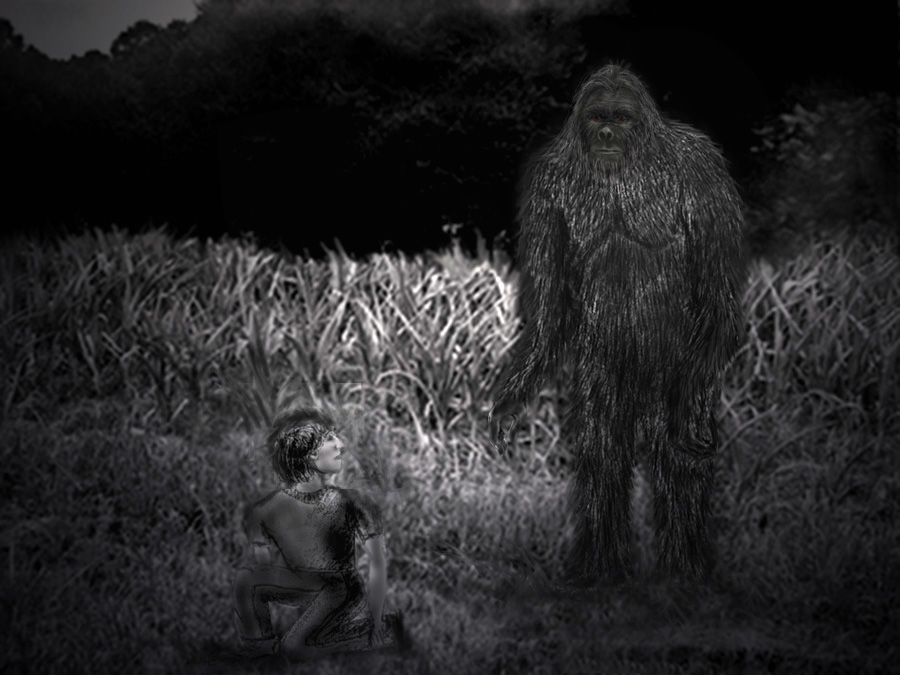
A retrospective depiction of the cornfield encounter, informed by artwork from Lunsford's brother. Drawing by Sybilla Irwin © 2010, via the BFRO case archive.
Both artworks are by Sybilla Irwin (2010) and are shown here as documentary illustrations of Lunsford's later recollections. They are not photographs of the creature. Art © Sybilla Irwin 2010; source: BFRO Report #27908.
The distinction matters: the sketches are real documentary evidence of what Lunsford described in 2010—not physical evidence that the creature he described existed. They also give us a rare chance to see the particulars of a witness's own memory instead of having someone else decide what “Bigfoot” ought to look like.
The local newspapers went looking for the man behind the story
By July 2010, The Record of Wilkes County had published a story titled “Bigfoot in Wilkes?”, dated July 21. The BFRO linked to that piece in its case file, and noted that the newspaper coverage arrived just a month after Lunsford's report. The original newspaper link is no longer reliably accessible in the online archive we found.
Then in August 2010, Winston-Salem Journal reporter Tim Clodfelter interviewed Lunsford for a broader report about the purported sighting. Lunsford described the figure as broad as a refrigerator, remembered its large dark eyes, and recalled an overwhelming mildew-like smell. Clodfelter also spoke to investigator Irwin, who said she believed Lunsford was being truthful.
Even Wilkes County Sheriff Dane Mastin weighed in. He treated the subject with humor; there was no sheriff's investigation confirming the encounter. The newspaper report is valuable for a different reason: it documents that Lunsford was willing to speak publicly, on the record, with his name attached. Read the contemporaneous 2010 reporting preserved by GhostTheory, with Clodfelter's original newspaper text →
There's also an intriguing secondhand detail. Lunsford told the BFRO that a relative of his former wife, who lived near the same mountain, said she had seen a similar upright figure. The account gives no independently published statement from that woman, however. We can't count it as a separately verified eyewitness report.
Then he planned to go back into those woods
In February 2011, the story took a turn. After more than three decades of wondering what he saw, Lunsford announced he wanted to return to the Roten Creek Road area with a search party.
He told journalists he was looking for evidence, not trying to kill a creature. News coverage said about 50 people had expressed interest, and he asked participants not to bring guns or dogs.
The expedition was publicly announced for Saturday, March 5, 2011. Participants were supposed to meet around noon in the Food Lion parking lot on Highway 16 at Millers Creek, then travel up the mountain toward the encounter location.
Multiple contemporaneous reports document the plan: WFMY News 2's February 2011 coverage and a preserved newspaper account of the proposed expedition. Footage and interview clips were also discussed in a 2011 Bigfoot Lunch Club news roundup.
But what did the searchers find? We have not located independently verified photographs, track casts, biological samples, or a documented successful outcome from that announced expedition. The news reports establish that the search was planned; they should not be misread as proof that a group subsequently found Bigfoot.
What evidence do we actually have—and what is missing?
The surviving paper trail is more substantial than many regional folklore accounts, and that makes it worth examining. But its pieces support different things.
The strongest documentation: Lunsford's dated, named BFRO account filed June 21, 2010; detailed follow-up notes by a named investigator; two contemporaneous witness-informed illustrations; July and August 2010 newspaper coverage; February 2011 television reporting; and a documented proposal to revisit the encounter site.
The evidence we do not have: a photograph or recording of the 1978 figure; preserved biological material; verified footprints from the location; a contemporaneous 1978 police or newspaper record; an independent statement from the supposed other witness; or proof that the planned 2011 expedition recovered anything unusual.
The BFRO classified the account as Class A. That's its own category for a report it regards as a clear observation. It is not a scientific certification that a Sasquatch was present.
There's a reason that distinction matters to us. An interesting story doesn't become less interesting when we tell readers exactly what can be checked. This account is compelling because we can follow how it was preserved—from a frightened 20-year-old in a cornfield to a grandfather talking with his daughter, journalists, an investigator, and eventually a crowd of would-be searchers.
We've been collecting Bigfoot stories across western North Carolina
In our Fall 2023 issue of Foothills Digest, Ghosties, Witches, Haints & Spirits (Issue #23), we featured “Bigfoot,” beginning on page 10. Here's the actual spread. Click it to open the issue and keep reading.
A question for the people who remember Wilkes County in 1978
What gets me about this story is how ordinary everything was supposed to be. A young man trying to visit his girlfriend without being caught. A pair of headlights on a dirt road. A cornfield with a wooded hill rising behind it. Then a moment he said he could never forget.
And then, in 2010, the decision to finally let other people hear about it, even knowing they might laugh.
Were you living around Wilbar, Roten Creek Road, or Millers Creek in the late 1970s? Do you remember the 2010 newspaper reports or the 2011 search plans? We especially want to hear from anyone who attended the proposed March 2011 expedition, remembers the original Record of Wilkes County coverage, or has firsthand photographs or records that weren't published.
And if you recognize the name Rick Lunsford, we'd be interested in speaking with him—or family members willing to share his recollections—before adding anything to the historical record.
More North Carolina Bigfoot stories
We’ve put all our investigations and other reported encounters together in one place. Back to the North Carolina Bigfoot archive → Browse the stories by county, compare the evidence, and explore our original magazine coverage.
Original records and further reading
- BFRO Report #27908 — Lunsford's June 21, 2010 first-person submission, original 1978 location and account, and Sybilla Irwin's follow-up.
- Original witness-assisted facial illustration — Sybilla Irwin, 2010, BFRO archive.
- Original reconstructed cornfield encounter illustration — artwork informed by material from Lunsford's brother, BFRO archive.
- Tim Clodfelter's August 2010 Winston-Salem Journal reporting, preserved by GhostTheory — Lunsford, investigator, and sheriff interviews.
- WFMY News 2, February 24, 2011 — Lunsford's planned return search and television coverage.
- “Bigfoot search planned in North Carolina,” February 28, 2011 — the proposed March 5 expedition and its rules.
- BFRO's Wilkes County report index — other reports, including the 2019 deer-stand encounter.
- Foothills Digest Issue #23, pages 10–11 — our earlier Bigfoot feature.
Editorial note: The 1978 encounter is an unverified eyewitness claim reported decades later, not proof of an unknown species. The 2010 drawings are retrospective illustrations of testimony, not scene photographs. Images by Sybilla Irwin © 2010, source BFRO. Featured photograph by Johny Goerend/Unsplash is illustrative and does not depict the reported site.
The best of our hills, in your inbox.
One good story, beautiful mountain views, and around 20 ideas for the weekend—with festivals first. No clutter. Just Foothills This Week.