The Night a North Carolina Man Called 911 on Bigfoot — and Ran It Off with a Stick

Two Bigfoot Sightings, Four Months Apart, in Alexander County, North Carolina
In 1874, a North Carolina Preacher Prayed for the Mountain to Shake. The Next Day, It Did.
On February 9, 1874, a farmer and self-styled preacher named Posey Owensby reportedly finished a revival meeting in the mountains above what is now Lake Lure, North Carolina. According to newspaper accounts, he had asked God to shake the mountains beneath the feet of local sinners and awaken them to the error of their ways.
The next day, the earth began to tremble.
There were booms that sounded like explosions, vibrations beneath houses, and long, low rumblings from the ridges overlooking Hickory Nut Gorge. And the strange noises did not stop after one night. They continued, on and off, for weeks.
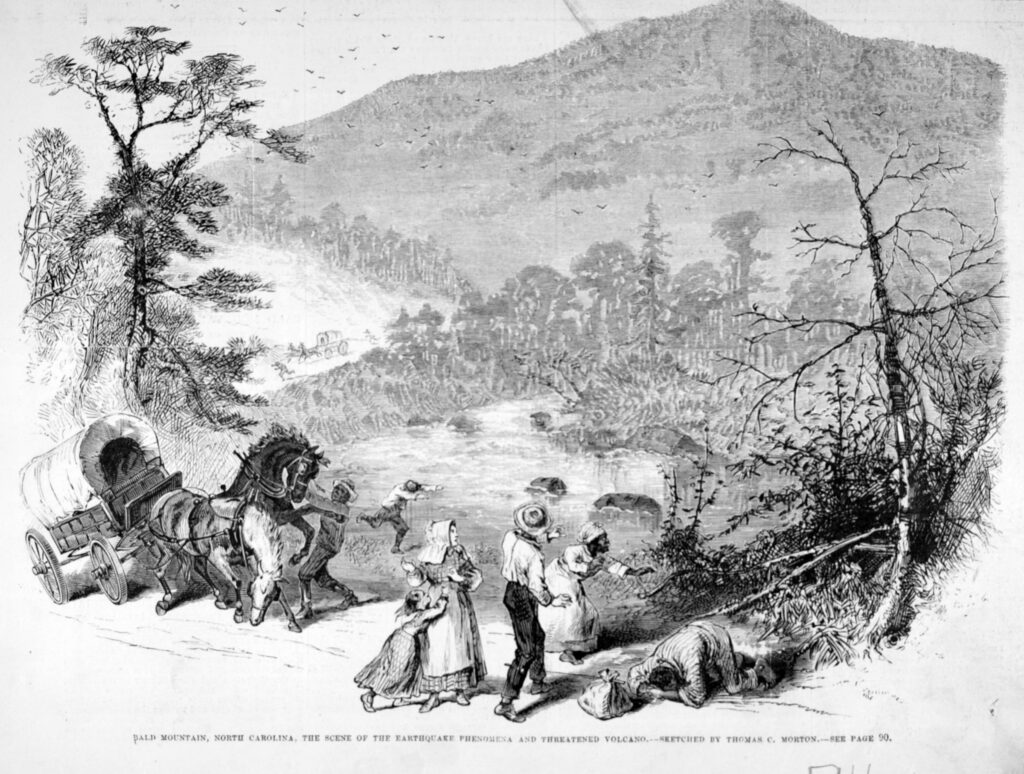
This is not a ghost story assembled from vague memories long afterward. The shaking was reported in newspapers while it was happening. A geologist went to investigate. His findings were published by the Smithsonian Institution. And Harper's Weekly sent images of the trembling mountain into homes across America.
A prayer, a tremor, and a terrifying coincidence
Owensby was described as a farmer who lived on the McDowell County side of Stone Mountain, near the Rutherford County line. Newspaper reports placed the end of his three-day revival on February 9. On February 10, 1874, residents began reporting the unusual earthquake-like activity.
The timing was irresistible to nineteenth-century storytellers. Imagine living on a mountainside in 1874, hearing someone call on heaven to shake the earth, then feeling the ground shudder the very next morning. Even a person who understood earthquakes would probably remember that sequence for the rest of their life.
Some reports said the noises could be heard miles away. Others described trembling windows and dishes rattling on shelves. Several newspapers circulated much wilder claims: cracks opening in the mountain, smoke rising from the summit, melting snow, buildings collapsing, and a volcano preparing to erupt.
There was one substantial problem. A great many of the more dramatic claims weren't true.
The newspapers made it sound like the end of the world
The story spread far beyond western North Carolina. The New York Herald, New York Tribune, Harper's Weekly and other publications told readers about a mountain on the verge of catastrophe. Accounts described frightened residents leaving their homes, preachers drawing crowds, and people repenting of their sins.
One particularly memorable detail in the national coverage involved a moonshiner who reportedly decided it was time to confess his activities to the authorities. You can see why editors loved the material. A booming mountain, a preacher's prayer, possible volcanic fire, and a sinner suddenly worried about judgment? It practically wrote itself.
But there is something worth noticing about the coverage. Much of the Northern press treated the people living in these mountains as ignorant curiosities. Reporters described Appalachian families in degrading terms and turned the community into a spectacle. That version of the story traveled much farther than the quieter testimony of the residents themselves.
And when a scientist actually went there and talked with people, he discovered a different picture.
A scientist went up the mountain to find out
In March 1874, Warren DuPre, a professor at Wofford College in Spartanburg, South Carolina, traveled to the area with students and other companions. The party arrived at Rutherfordton on March 18 and worked its way through Hickory Nut Gorge, around Bald, Shumont and Stone mountains, gathering accounts from residents.
DuPre did not dismiss the disturbances. He took the sounds and shaking seriously. But he also checked the supposed evidence for an eruption. He investigated whether blasting associated with the Western North Carolina Railroad near Old Fort could have caused the noises, and concluded it did not explain them.
He believed the center of the disturbances lay beneath Stone Mountain. His initial ideas included volcanic activity, but his later published explanation favored natural geological changes in the mountains. No eruption followed. The exact underlying mechanism of the 1874 swarm is not established to modern scientific certainty, but the reported tremors fit earthquake activity far better than the lurid newspaper stories of a mountain splitting open.
DuPre also found that residents themselves contradicted tales of smoking peaks, giant fissures and other sensational details. In other words, the people living beside the mountain were often more measured than the people writing about them from afar.
Look at what readers saw in 1874
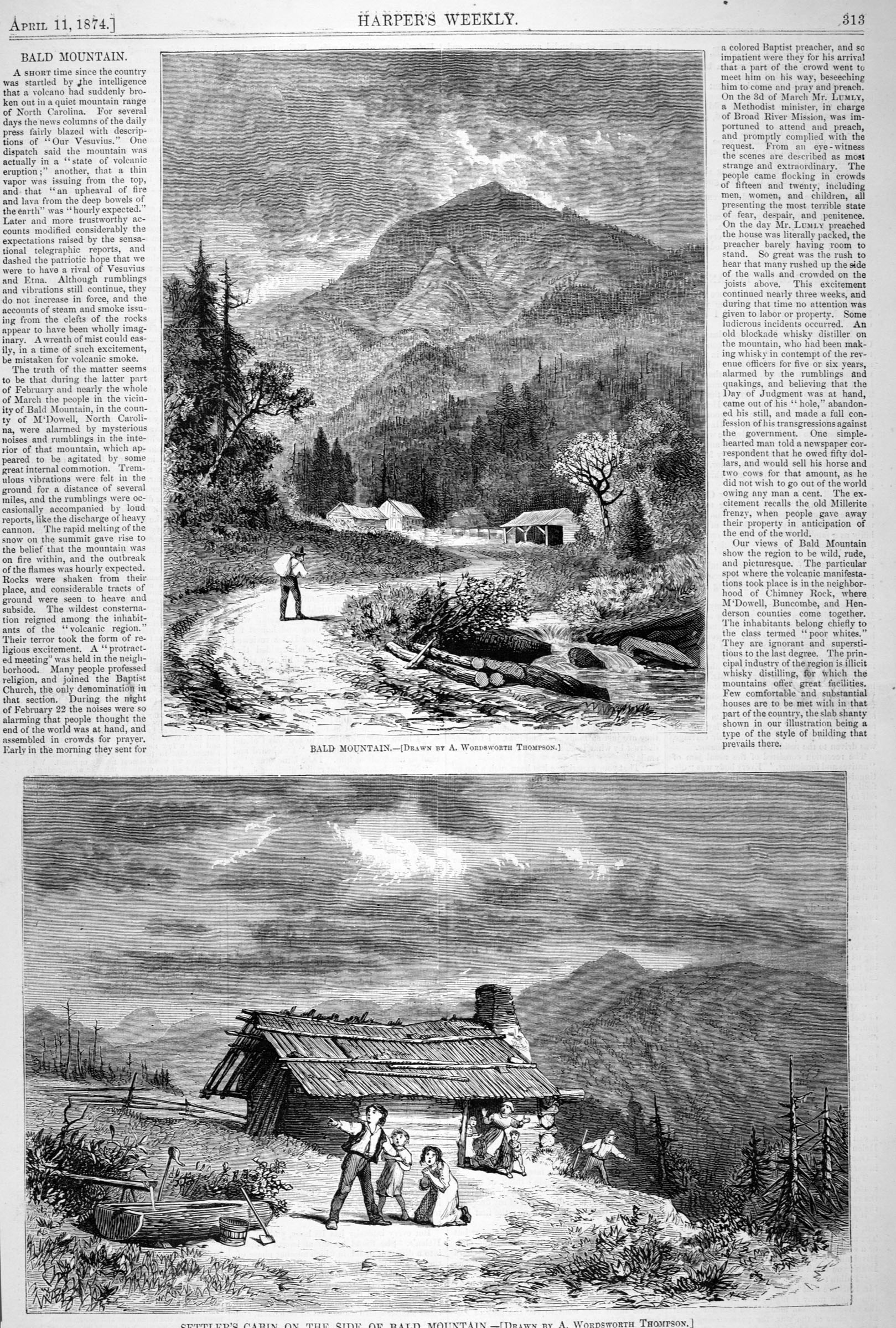
Historical illustration from the 1874 Bald Mountain coverage, reproduced from a public-domain nineteenth-century print via Wikimedia Commons. It is an artist's interpretation, not a photograph or documentation of volcanic activity.
Harper's Weekly published engravings showing the mountain and its residents in the midst of the alarm. These pictures are a wonderful piece of the historical record, but they tell us as much about how nineteenth-century editors wanted their readers to see rural North Carolina as they do about what happened there.
We told this story in our spooky issue
Back in Fall 2023, we included the story in Foothills Digest Issue #23, Ghosties, Witches, Haints & Spirits. Our original feature, “Rumblings on the Bald,” appears on page 24. Below is the actual magazine spread, using our “See It in the Magazine” viewer. Click the magazine image to open the original issue to the relevant page.
The spread opens at printed page 24, followed by page 25's “Battle of the Little People,” another piece of Chimney Rock folklore from the same issue.
The mystery didn't end in 1874
One modern historical summary, drawing on United States Geological Survey records, reports at least 75 shocks between February 10 and April 17, 1874. The activity gradually quieted. There was no volcanic eruption, but the experience left a name behind: Rumbling Bald.
Even the great French adventure novelist Jules Verne was intrigued by accounts of a thunderous North Carolina mountain. His 1905 novel Master of the World imagined a much stranger secret hidden in a mountain in this region.
What I find most fascinating is that the remarkable part of this story isn't the possibility of divine intervention or a sleeping volcano. It's that the earthquakes really happened. A preacher's reported prayer and a natural event fell almost perfectly on top of one another in time, and an entire country turned the coincidence into a morality tale about the people who lived in our mountains.
Today, when you look out across Hickory Nut Gorge, it's easy to think of those old ridges as solid and unchanging. But in February 1874, the land beneath the people who called them home was moving. They heard it. They felt it. And for a few weeks, the rest of America couldn't stop talking about it.
Explore the original records
- Asheville Museum of History's detailed historical investigation, including DuPre's route and the exaggerated newspaper coverage.
- March 26, 1874 newspaper report preserved in the University of South Carolina's newspaper collection.
- NCpedia's overview of North Carolina earthquakes, including the 1874 Harper's Weekly illustration.
- Foothills Digest, Issue #23, page 24 — our 2023 article “Rumblings on the Bald.”
The best of our hills, in your inbox.
One good story, beautiful mountain views, and around 20 ideas for the weekend—with festivals first. No clutter. Just Foothills This Week.